Fascinating Facts & Beauty of Olive Ridley Turtles
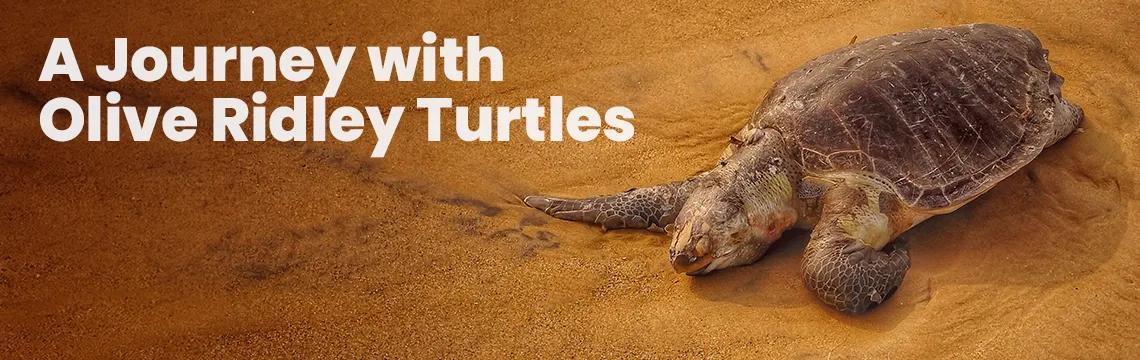
Some journeys are measured in kilometres. Others seem to belong to a much older rhythm, guided by tides, instinct and the quiet pull of a familiar shore. Every year, Olive Ridley turtles travel through tropical waters and return to selected beaches to nest, creating one of the natural world’s most stirring spectacles.
Along the coast of Odisha, places such as Rushikulya and Gahirmatha are closely associated with these marine travellers. During mass nesting, females emerge from the sea in remarkable numbers, cross the sand and dig nests for their eggs. The event is known as an arribada, a Spanish word meaning “arrival”.
Yet the beauty of Olive Ridley turtles is not only found in the scale of an arribada. It lies in the contrast: a small sea turtle undertaking an enormous ocean journey, a powerful swimmer appearing slow and vulnerable on land, and tiny hatchlings beginning life with a hurried crawl towards the waves.
What makes Olive Ridley turtles special?
The Olive Ridley, scientifically known as Lepidochelys olivacea, takes its common name from the olive-green colour of its heart-shaped shell. Adults are generally around 60 to 75 centimetres long and may weigh up to roughly 45 kilograms, making them one of the smaller sea turtle species. They inhabit tropical regions of the Pacific Ocean, Indian Ocean and Atlantic Ocean.
Their relatively modest size can be misleading. Olive Ridley turtles spend much of their lives in the open ocean, feeding on marine life such as crabs, shrimp, jellyfish, fish and other organisms. Their streamlined shells and strong front flippers are designed for movement through water rather than across land.
Most strikingly, Olive Ridleys use more than one nesting strategy. Some females nest alone, while others participate in synchronised mass-nesting events involving thousands of turtles. Only a limited number of beaches around the world host arribadas of this scale, which makes the nesting coastline of Odisha particularly significant.

Understanding the Olive Ridley turtles breeding season

The Olive Ridley turtles breeding season is not identical in every part of the world. Along the Odisha coast, mating and nesting activity generally builds during the cooler months, with major nesting events often occurring between February and March. The precise timing can shift from year to year because of tides, weather, beach conditions and other environmental cues.
When a female reaches the beach, she moves beyond the waterline and selects a suitable patch of sand. Using her rear flippers, she carefully excavates a flask-shaped nest, deposits a clutch that may contain around 100 eggs, covers it and returns to the sea. Incubation commonly lasts about 45 to 65 days, although temperature and local conditions can affect the period.
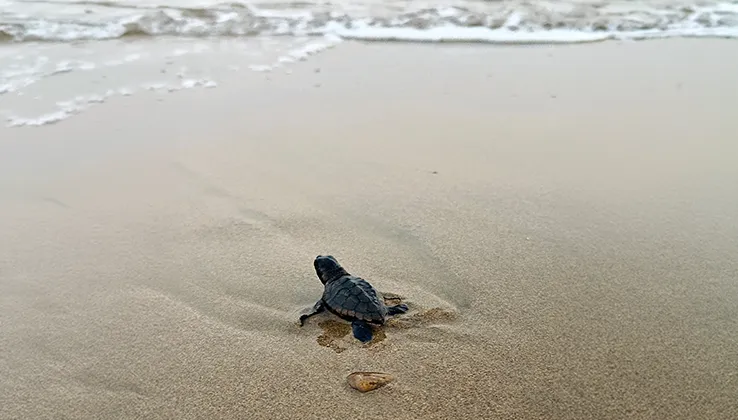
The hatchlings usually emerge together and instinctively move towards the brighter horizon over the sea. It is a short journey across the sand, but also an exposed one. Artificial lighting, litter, predators and human movement can make that first passage more difficult. Travellers should remember that an arribada cannot be scheduled like a conventional attraction. Access may be restricted, viewing zones can change and some sensitive stretches may be closed entirely. Local forest and wildlife authorities determine when, where and whether public observation is permitted.
Where can Olive Ridley turtles be seen in Odisha?
Rushikulya River Mouth: Known for dramatic mass nesting along its open, sandy shore. The experience feels wonderfully wild, though barriers and controlled access help keep turtles safe.
Gahirmatha Marine Sanctuary: A protected coastal habitat near Bhitarkanika, combining turtle nesting grounds with mangroves, creeks and mudflats.
Devi River Mouth: A quieter nesting area where sightings are less predictable and access depends on conservation activity.
Bhubaneswar is a practical starting point for exploring the coast and combining a wildlife journey with Odisha’s temples, crafts, food and wetlands. Travellers can search for Bhubaneswar flight tickets by entering their departure city and intended travel dates. Current schedules and availability should guide the final itinerary. Those hoping to book flight tickets to Bhubaneswar around the Olive Ridley turtles breeding season may find it useful to keep a flexible coastal plan. The turtles follow natural cues, not a tourism calendar, and an anticipated nesting date may shift. A spare day can make the journey less rushed, even if no mass nesting occurs.
Comparing nearby travel dates may also help travellers find affordable flight tickets. Selecting dates first and building the wildlife plan around a rigid prediction can be frustrating. A more relaxed itinerary might begin in Bhubaneswar, continue towards the coast and include heritage or nature stops along the way.
Travellers ready to book affordable flight tickets can review live flight options directly. Fares, schedules and availability can change, so the booking flow remains the most reliable place to compare current choices.